
Croydon schools report a strong year, with a record 98% Distinction or Merit at The BRIT School. If a grade looks wrong, the fast appeal closes on 20 August.
Croydon’s sixth formers picked up A-level, T-level and Level 3 vocational results on Thursday 13 August, and the borough’s schools are reporting one of their better years. The council said early indications show students “maintained last year’s strong performance”, and that Croydon’s BTEC cohort is again running ahead of the country, holding an overall average grade of Distinction against a national average of Merit (Croydon Council).
The single most useful thing to know this week is not in any of the celebration, though. If a grade looks wrong, the fast track for getting it re-marked closes on Thursday 20 August, five days from now, and it has to be your school or college that submits the request, not you.
What the borough’s schools reported
The strongest set of numbers came from The BRIT School in Selhurst. A record 98% of its students achieved a Distinction or Merit in the UAL Level 3 Extended Diploma, the highest proportion of top grades in the school’s history, with 82% taking the top Distinction grade. Of those who applied to university, 98.9% got their first choice. In academic A-levels, 70% of grades were A* to C. Principal Stuart Worden said these were “our best results ever and our students are progressing to incredible colleges, universities and careers”.
Norbury High School for Girls in Thornton Heath reported 93% of students meeting or exceeding their target grades, and more than 10% taking places at Russell Group universities. The school said students from disadvantaged backgrounds took 17% of its A*-A grades, above the cohort average, and that it recorded its highest average point score since before the pandemic, putting student progress in the top 25% nationally.
Both sets of figures come from the council’s results-day statement. Neither school had published its own 2026 figures on its website when we checked on 15 August.
Why a school’s percentage will not match the national one
This is the bit results-day coverage almost never explains, and it matters if you are comparing schools.
Schools usually publish figures like A*-B, A*-C or A*-E, and often “including equivalents”, meaning vocational results are folded into the same percentage. The official statistics do not work that way. Ofqual reports grade A and above and grade C and above, for A-levels only (Ofqual). So a school’s A*-C is roughly comparable with the national C and above; an A*-B figure has no national equivalent at all and can only be set against that school’s own previous years.
Nationally, 28.3% of A-level results were at grade A and above this summer and 78.1% at C and above, from 835,950 results issued to 320,505 students. London was the strongest region in England at 32.7% A and above, up from 32.1% last year, against 23.1% in the North East and East Midlands.
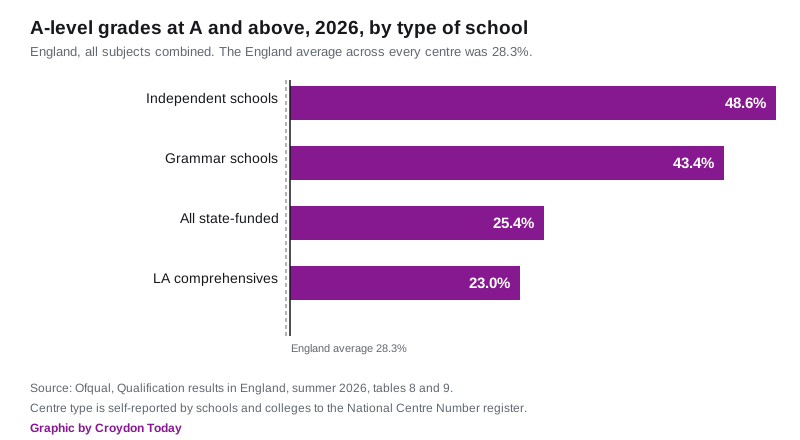
The other reason to be careful with league tables: centre type does most of the work. Independent schools recorded 48.6% of results at A and above and grammar schools 43.4%, against 25.4% across all state-funded centres and 23.0% at local-authority-maintained comprehensives. A comprehensive at 23% is performing at exactly the state-school norm, whatever a ranking implies.
Ofqual has published results by local authority district since 7 August, but only through an interactive map, and it carries a warning worth repeating: grades are assigned to an area by the postcode of the exam centre, not by where the student lives. A district containing a large selective or independent school ranks high on other people’s children. Treat any “best borough” ranking accordingly.
What it means for you
If a grade looks wrong, move now. The Joint Council for Qualifications sets two deadlines for summer 2026 (JCQ post-results services):
- 20 August for a priority review of marking. This covers A-levels, T-levels and Level 3 vocational qualifications only, and exists for students whose university place depends on the outcome. The awarding body has 15 calendar days to complete it.
- 24 September for a standard review of marking, and the same date for a clerical re-check, which just confirms the marks were added up and recorded correctly.
Three things families get wrong every year. The request goes through your school or college exams officer, not from you to the exam board. Your written consent is required before it is submitted. And there is no grade protection: a review can send a mark, and a grade, down as well as up.
If you did not get the grades you needed, contact the university, college, training provider or employer before you assume the place is gone, and do it early rather than at the end of the week. If you did better than expected, the same applies in reverse.
Croydon Council’s Post-16 Participation Team gives free advice on next steps on 020 8726 7485 or at Post16@croydon.gov.uk. For students who want to talk to someone outside the school, Croydon Drop In offers support to young people across the borough.
GCSE results land on Thursday 20 August, the same day the priority A-level deadline closes (Ofqual). Level 2 vocational results reach students on or before that date. If you have a child collecting GCSEs next week and an older one weighing up a remark, both jobs fall on the same morning.
If you are travelling into the town centre for results or an open day next week, our roadworks and travel page has the current closures, and things to do in Croydon covers what is on over the rest of the summer.
Have your say