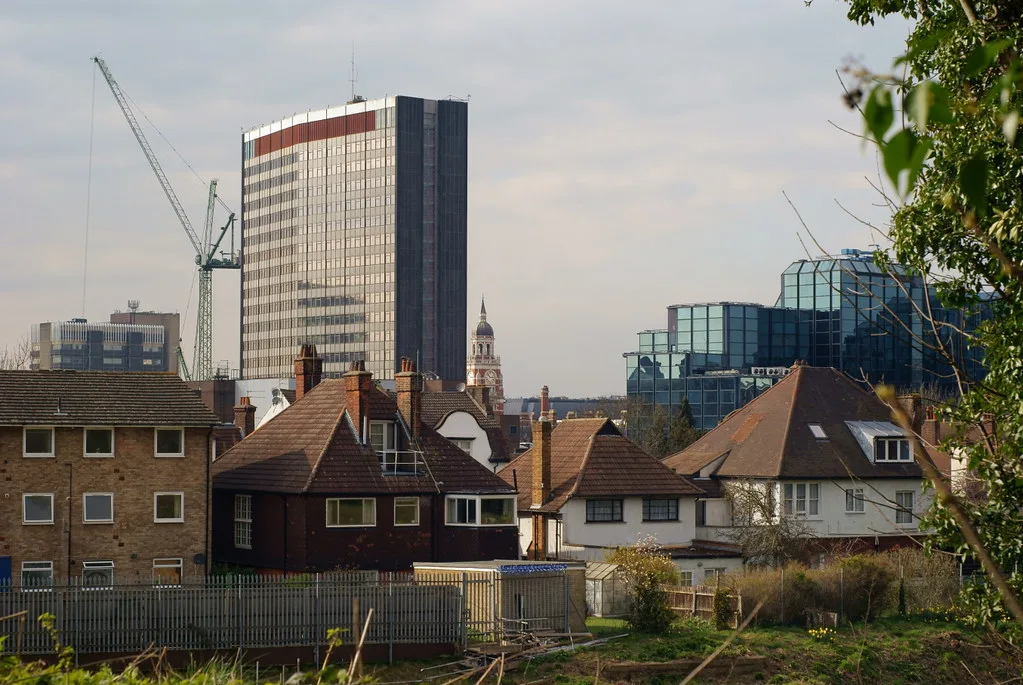

Six ways to search the Croydon planning register, the pre-2018 ward trap that returns nothing, and why your address goes public the moment you comment.
Every one of the Croydon planning applications submitted in the borough, from a loft conversion in Sanderstead to a tower in the town centre, lands on the same public register, and anyone can read it for free without an account. Most people find out a scheme exists when the scaffolding goes up, by which point the window to say anything has closed. This guide covers where the register is, how to pull up the weekly list of everything newly submitted, how long you have to comment, what the council is legally allowed to take into account, and what happens once your comment is in. All of it comes from Croydon Council’s own guidance.
Where Croydon planning applications live
The council calls its system the Planning Register, and it runs on the Idox Public Access platform. It is here:
No login is needed to look. The register holds current and past applications, appeals against applications, and enforcement cases, so it is also the place to check what a neighbour was actually given permission to build, and on what conditions.
You can search it three ways:
- Simple search by address, postcode, or application reference.
- Advanced search, which lets you filter by ward, date range and application type.
- Weekly and monthly lists, which show everything registered or decided in a period.
A Croydon reference looks like 24/02960/PDO. The first two digits are the year the application was submitted, the middle block is the running number, and the suffix is the application type: FUL is a full application, PDO is a section 106 variation, and so on. The council uses this format on its own pages, for instance when publishing the Queen’s Hotel public inquiry papers, which cite reference 24/02960/PDO and the earlier permission 18/00831/FUL for the same Crystal Palace site.
The weekly list is the thing to bookmark
If you only use one page, use this one:
It gives you a dropdown of recent weeks and a dropdown of every Croydon ward, from Addiscombe East and West through Bensham Manor, Broad Green, Coulsdon, Purley, Selsdon, Thornton Heath and the rest. Pick your ward, pick the week, and you see everything validated in that seven day period near you. A monthly list works the same way. This is how you find out about a scheme in week one rather than week ten. The applications that matter beyond a single street are also written up in Croydon Today’s news.
Set up alerts instead of remembering
Better still, let the council’s system watch for you. Register a free account on the Planning Register and you can track individual applications and save searches, then receive email notifications when anything matching comes in. The council publishes a guidance PDF on registering and tracking applications. If you care about one street or one ward, save that search once and stop checking.
Croydon planning search: the six ways in, and the ward trap
People conclude an application “is not on the register” far more often than one is actually missing. Almost always it is on there and the wrong search was used. The Croydon planning search is not one box, it is six, and they sit behind the tabs across the top of the register.
- Simple search. One box, for an address, a postcode or a reference. Fastest when you know exactly where. Weakest on anything registered against a neighbouring plot, a field, a garage block or a site with no street number.
- Advanced search. The one worth learning. It filters by description keyword, applicant name, agent, ward, conservation area, application type, status, decision and date range, and it takes an application reference, a Planning Portal reference or an alternative reference. This is how you pull every “change of use” in one ward, or every application a particular developer’s agent has lodged across the borough.
- Weekly and monthly lists. Everything validated or decided in a period, by ward. Covered above, and the page to bookmark.
- Property search. Searches the address record rather than the applications, so it returns the full planning history of one property in one go. This is the one to use before buying a house.
- Map search. Plots applications on a map of the borough. Use it when you know roughly where the site is but not its official address.
- Building Control. A second, separate register with its own simple, advanced, weekly, property and map searches. Croydon exposes this publicly, which many London boroughs do not, and it is where the structural and regulations side of a job appears rather than the planning side. If a neighbour’s work needed building control but not planning permission, this is the register it will be on.
One tab does triple duty. The applications form searches applications, appeals and enforcements, and you pick which with the buttons above the fields. If a scheme has vanished from the applications list, try the appeals and enforcement searches before assuming it went away: the Status filter carries “Appeal lodged” and “Appeal decided” alongside “Awaiting decision” and “Decided”, which is usually where a refused scheme has gone.
The ward trap. Croydon redrew its wards at the May 2018 election, and the ward dropdown still carries both sets. Alongside Addiscombe East and Addiscombe West you will find “Addiscombe - Pre May18 Election”, and the same doubling runs through Bensham Manor, Broad Green, Norbury, Purley, Sanderstead, Selhurst, Shirley, Thornton Heath, Waddon, West Thornton and Woodside. An application registered before May 2018 is filed under the old ward name, so a ward search for anything older than that has to use the “Pre May18 Election” entry or it returns nothing. The list also holds “Out Of Borough” and “Unknown”, which is where a handful of cases with unresolved addresses sit.
The other reason a search comes back empty is the reference format. Croydon’s application types run to more than a hundred suffixes, from FUL and HSE through LDC, DIS, NMA, TRE and PA variants, so typing a reference from memory with the wrong suffix will fail where the number alone, or the address, would have worked.
How long you have to comment
Croydon does not publish a single fixed consultation length that applies to every application, so do not rely on a number you half remember. The deadline is shown on each application’s own page in the Planning Register, and that is the figure to work to.
What the council does commit to is how it tells people. When an application is registered it is made public, and the council says it will publicise it by writing to the immediate neighbours of the site. Site notices go up in certain circumstances, typically for larger developments or where the address of the land is unclear (after submitting a planning application).
The practical consequence is that if you are not an immediate neighbour, no letter is coming. The weekly list, or a saved search alert, is the only reliable way to hear about a scheme two doors further down.
How to comment, and what to include
Comments go in through the Planning Register itself. The council asks that every comment includes:
- your contact details,
- the type of commenter you are, for example neighbour or Member of Parliament,
- whether you object, support or are neutral, and
- the reason for your comment.
What counts, and what does not
This is where most objections are wasted. The council can only weigh planning matters, and it is direct about the limits: “By law, we can not reject an application unless it goes against planning policy.” The number of objections received does not change that. A hundred comments raising points the council cannot consider carry less weight than one that engages with policy.
Croydon’s own guidance on preparing your comments sets out both lists.
Points the council can uphold:
- harm to trees
- significant loss of light
- ongoing noise after construction is finished
- new windows or spaces that overlook your house or garden
- traffic congestion
- design not in keeping with the area
Points the council cannot uphold:
- the impact on property values
- predicted noise during construction
- who will use the development once it is built
- disputes with neighbours
The pattern is worth internalising. Permanent effects of the finished building on the surrounding area count. Temporary disruption, commercial or personal grievances, and who ends up living or working there do not. An objection about construction lorries will not land; the same objection reframed around permanent traffic congestion at a junction might. If your concern is about where the extra cars will go, the borough’s controlled zones and car parks are set out separately in our guide to parking in Croydon.
What is published, and what is not
Croydon is unusually specific here, and it surprises people. Once you submit, “your address and stance will immediately be made available online to the public”. Your address and whether you objected, supported or were neutral go on the register straight away.
What the council does not display publicly is your text comments, telephone number and email address (after you submit a comment). The substance of what you wrote is read by the case officer and reported to committee where relevant, but it is not published on the website alongside your name.
Who decides, and how long it takes
When an application arrives, the council checks it is complete and writes within 5 working days if anything is missing. It cannot be registered until everything is in. Once registered, the applicant is given an estimated decision date of 8, 13 or 16 weeks depending on the type of application.
The planning service sits alongside the borough’s other functions funded by the Croydon element of the council tax bill, which is broken down in our guide to Croydon council tax bands.
Most decisions never reach a politician. They are made by senior officers under delegated powers. Officers read every comment and check it is valid, though the council warns they cannot respond individually with updates.
More complex or potentially controversial applications go to a Planning Committee or sub-committee, where councillors decide in public. If you commented on an application heading to committee, the council will contact you by email or letter around 5 working days before the meeting, telling you the date, the time and how to apply to speak.
Speaking time is tight and evenly split. There is one slot per application for objectors and one for the applicant or supporters, limited to 3 minutes each. If several neighbours object, you get one three minute slot between you, so agree in advance who speaks and what they will say. If you would rather not speak, your comment is still reported to the committee.
The council also publishes a set of plain guidance notes, including note 3 on what happens to an application, note 4 on how to comment, and note 5 on how the council decides applications.
Frequently asked questions
How do I search Croydon planning applications?
Use the council’s Planning Register at publicaccess3.croydon.gov.uk/online-applications. Search by address, postcode or reference number, or use the advanced search to filter by ward and date. No account is needed to view applications.
Where is the weekly list of Croydon planning applications?
At publicaccess3.croydon.gov.uk/online-applications/search.do?action=weeklyList. Choose a ward and a week to see everything registered in that period. A monthly list is available from the same menu.
How long do I have to comment on a Croydon planning application?
Croydon does not publish one fixed period covering every application. The deadline for the application you care about is shown on its own page in the Planning Register, so check there rather than assuming a standard number of days.
Will my comment on a Croydon planning application be made public?
Partly. Your address and whether you objected, supported or were neutral are published on the register immediately. Your written comments, phone number and email address are not displayed publicly.
What objections does Croydon Council actually take into account?
Harm to trees, significant loss of light, ongoing noise after construction, overlooking of your house or garden, traffic congestion, and design out of keeping with the area. It cannot take account of property values, construction noise, who will occupy the development, or neighbour disputes.
Why can I not find an application on the Croydon planning search?
Usually the wrong search was used rather than the application being missing. Try the property search, which returns a whole address’s planning history, or the map search if the site has no street number. If it was refused, switch the search type from applications to appeals or enforcements. And if you are filtering by ward, check whether you need the “Pre May18 Election” version of the ward name, because anything registered before May 2018 is filed under the old boundaries.
Does the Croydon planning register cover building control?
Yes, as a separate register with its own simple, advanced, weekly, property and map searches, reached from the Building Control tab. Work that needed building regulations approval but not planning permission appears there and nowhere in the planning applications list.
Can I speak at a Croydon planning committee?
Yes, if your application goes to committee. The council contacts commenters about 5 working days beforehand with the date, time and how to apply to speak. There is one 3 minute slot for objectors and one for the applicant or supporters. Your comment is reported to the committee whether or not you speak.
Sources
- Croydon Council Planning Register and its weekly list of applications
- Croydon Council, comment or object to a planning application and prepare your comments, for the material and non-material considerations
- Croydon Council, add your comment to the Planning Register, for what a comment must include and how to track applications
- Croydon Council, after you submit a comment, for publication rules, committee notification and the 3 minute speaking slots
- Croydon Council Planning Register, advanced application search, for the ward list carrying both current and “Pre May18 Election” wards, the application type and decision lists, and the appeal and enforcement search types, checked 7 September 2026
- Croydon Council Planning Register, property search, map search and the separate building control search
- Croydon Council, after submitting a planning application, for the 5 working day validation check and the 8, 13 or 16 week decision targets
- Croydon Council, Queen’s Hotel, 122 Church Road public inquiry, for the reference format
Checked against Croydon Council’s planning pages on 4 August 2026. Deadlines and application statuses change, so confirm on the Planning Register before relying on a date. For where the borough’s big schemes and the Local Plan stand, see our Croydon planning news page.
Have your say