
Croydon's claimant count rose to 16,880 in August, 6.3% of working-age residents: the sharpest monthly rise since June 2025, with under-25s at a five-year high.
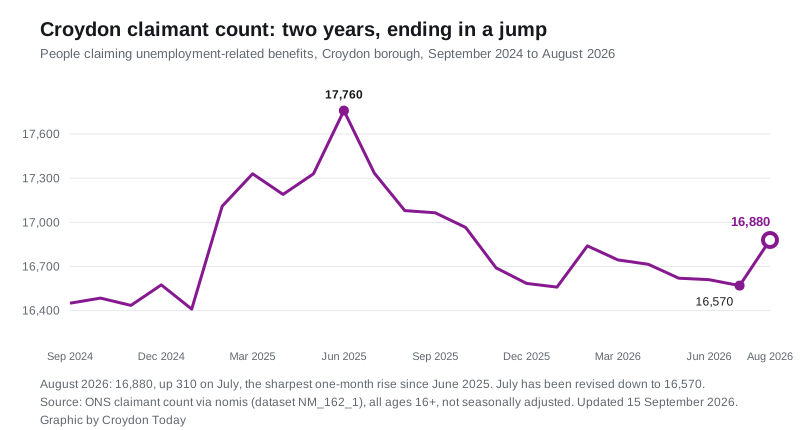
16,880 people in Croydon were claiming unemployment-related benefits in August 2026, equal to 6.3% of residents aged 16 to 64. The figures were published through nomis on 15 September.
That is 310 more people than in July. It is the sharpest one-month rise the borough has recorded since June 2025, and it ends five consecutive monthly falls.
The year-on-year picture is still the better one. August 2025 stood at 17,080, so Croydon is 200 claimants below where it was twelve months ago. What changed in August is the direction of travel.
Every age group went up, and the youngest went up most
The rise was not concentrated in one group. All three age bands rose in August:
| Age band | August 2026 | Change on July | Change on a year |
|---|---|---|---|
| 16 to 24 | 2,930 | +80 | +120 |
| 25 to 49 | 9,780 | +100 | -370 |
| 50 and over | 4,170 | +130 | +55 |
Two of those numbers are worth pausing on.
2,930 under-25s is the highest Croydon has recorded since October 2021, when the count was still falling away from the pandemic peak. Young claimants have now risen for two months running, and at 120 above last August they are up 4.3% on the year, the fastest annual increase of the three bands.
4,170 claimants aged 50 and over is the highest since July 2025. Between them, the under-25s and the over-50s account for 210 of August’s 310-person rise, while the 25 to 49 band, which is more than half the total, is still 370 below last August.
These are headcounts, not rates. The nomis table returns no percentage when the figures are broken down by age, so the 6.3% rate exists only for all ages together.
Eleventh of 33 boroughs, fifth by headcount
Croydon’s rate of 6.3% is the eleventh highest of London’s 33 boroughs. Ten boroughs are above it, led by Newham, Haringey and Barking and Dagenham on 7.4%, with Ealing immediately above Croydon on 6.4% and Lambeth immediately below on 6.2%.
By raw numbers Croydon is fifth in London, behind Newham (20,010), Brent (17,475), Tower Hamlets (17,130) and Ealing (16,995). Croydon is one of London’s largest boroughs by population, which is why it ranks higher on headcount than on rate.
On the same series, London stood at 5.5% in August and the United Kingdom at 3.9%.
A correction to the figure we published last month
In August we reported Croydon’s July claimant count as 16,835. The same series now records July as 16,570, a downward revision of 265.
That is not an error in either number. The ONS explains in its Claimant Count methodology that the Universal Credit part of the count “allows for revisions to the data for one previous month”, so the newest month in any release is the one most likely to move. June’s figure, 16,610, is unchanged from what we published, which is what you would expect.
It matters for reading August’s rise. Against the July figure as first published, August would look like a rise of 45. Against the revised July figure, which is the like-for-like comparison, it is a rise of 310.
What this number is not
It is not the unemployment rate. The ONS is explicit that the claimant count “does not attempt to measure unemployment, which is a concept defined by the International Labour Organisation”. It counts people claiming benefits principally because they are unemployed, taken from the benefits system’s own administrative records.
It includes some people who are working. Universal Credit claimants on low enough earnings are still required to look for more work, and they are counted here. It also misses unemployed people who do not claim at all.
What it means for you
If you are claiming in Croydon, the council’s Council Tax Support scheme is the benefit most likely to change next. Cabinet is due on 23 September to decide whether to consult on cutting it, with any change taking effect in April 2027: our report on the Council Tax Support consultation sets out the four options and who they would hit.
If you are budgeting, the council tax band for your address is the fixed cost worth checking first, because support is calculated against it.
The next figures, for September 2026, are due from the ONS on 20 October.
Sources
- ONS claimant count via nomis dataset NM_162_1, August 2026, for the borough series, the age bands and the London and UK rates. The dataset records the August figures as last updated at 07:00 on 15 September 2026
- nomis dataset NM_162_1, all 33 London boroughs, for the borough ranking
- ONS, Claimant Count QMI, for the definition and the revisions policy
- Our own July 2026 report, for the figure as first published
Have your say