

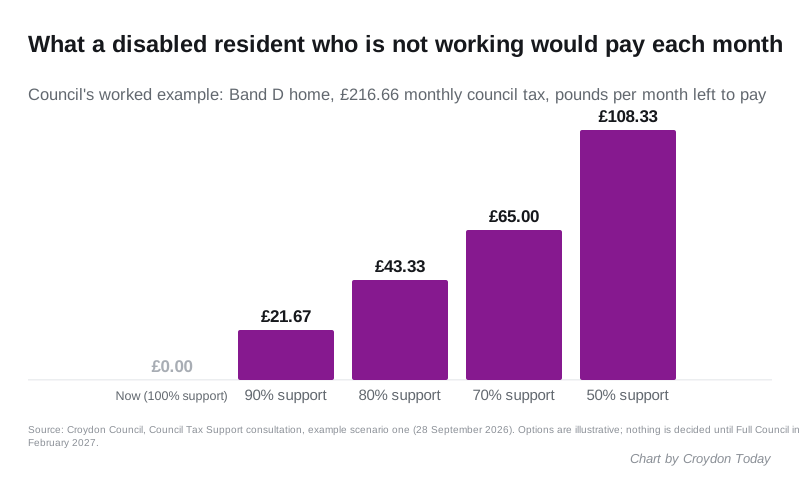
Croydon's consultation on cutting Council Tax Support is open until 9 November. A disabled resident who pays nothing now could pay up to £108 a month.
Croydon Council’s consultation on cutting Council Tax Support opened today, Monday 28 September. It closes at 11.59pm on Monday 9 November 2026 (consultation site).
The Executive Mayor and Cabinet agreed to run it on 23 September (decision 2799). Full Council makes the final decision in February 2027. Any change would apply from 1 April 2027, and only to working-age residents. Pensioners are covered by a national scheme and are not part of the review.
We covered the options when they first went to Cabinet (our 17 September report). The consultation site now puts them in pounds. It also adds two proposals the Cabinet decision did not list, and it puts a number on a third.
What it could cost you each month
The council gives four worked examples. Each is a claimant in a Band D home with a council tax bill of £216.66 a month.
| Example claimant | Pays now | Pays under the deepest option |
|---|---|---|
| Disabled, not working (currently 100% support) | £0.00 | £108.33 (50% support) |
| Lone parent with a four-year-old (currently 80%) | £32.50 | £81.24 (50% support) |
| Single person on Universal Credit (currently 75%) | £40.62 | £81.24 (50% support) |
| Disabled and working (currently 75%, £50 earnings ignored) | £40.62 | £97.49 (disregard removed) |
The disabled working example shows a trap in the income bands. If the £50 of earnings the council ignores is cut or removed, the claimant’s counted income rises into the next band. Their support then drops further than the headline percentage suggests: to 50% rather than 65%, or to 40% rather than 50%.
What the options would save
The consultation site sets out four sample packages, from a £3.6m saving to £11.9m a year. The council says they are not fixed choices. Any combination could go to Full Council after the consultation.
| Package | Disabled not working | Lone parent, child under 5 | Everyone else | Disabled working disregard | Saving |
|---|---|---|---|---|---|
| Option 1 | 50% | 50% | 50% | £0 | £11.9m |
| Option 2 | 70% | 50% | 50% | £0 | £8.5m |
| Option 3 | 80% | 70% | 65% | £25 | £5.3m |
| Option 4 | 90% | 70% | 65% | £25 | £3.6m |
The single largest saving is the disabled not working group. Cutting its support to 50% would save £8.5m of the £11.9m in Option 1.
The proposals that are new
The first two of these were not in the Cabinet’s list. The third was, but without a figure:
- A 30-day limit on backdating. At present, a change that increases your support can be backdated however long ago it happened. The council proposes 30 days, as with Housing Benefit and Universal Credit.
- Childcare costs only for people working 16 hours or more. Childcare would only be ignored when working out support for residents who work at least 16 hours a week. Some who work fewer hours could get less.
- A narrower “disabled not working” group. The extra protection would go only to people whose Universal Credit includes the LCWRA element (limited capability for work and work-related activity). The council says around 5,369 of the 8,628 residents in the group would still qualify. That means about 3,260 would not.
The other questions follow the rest of what Cabinet agreed:
- Cutting the maximum award for each group.
- Reducing the band cap from D to C, so support in a Band D home or above is worked out on a Band C bill. The cap could apply to disabled residents who are not working for the first time.
- Changing the savings limit, now £16,000 for protected groups and £8,000 for everyone else. The council says it could go down or up.
- Ignoring war disablement pensions and armed forces compensation. The Royal British Legion asked for this. No current claimant would be affected.
Who is on the scheme
The council’s equality impact baseline describes the people who claim:
- 70% of all claimants are of working age, so within reach of these changes.
- 71% of working-age claimants are women.
- 94% of single parent claimants are women.
- 49.6% of all claimants receive a disability benefit.
The council says the full assessment will be finished after the consultation. It will go to Full Council with the final proposals.
What it means for you
- If you get Council Tax Support and are under pension age, this is your chance to be heard. The online survey is on the consultation site (the short address croydon.gov.uk/cts goes there).
- Paper copies are at Croydon libraries and Family Hubs, and you can hand them back there.
- For help, another format or a call back, email CTSschemefeedback@croydon.gov.uk or ring 020 8726 6000 and choose the benefits option.
- The deadline is 11.59pm on Monday 9 November.
- Nothing changes before April 2027. The consultation site says hardship support or temporary protection would be considered for the residents hit hardest.
- To see what your band is charged, use our Croydon council tax bands page. The worked examples all use Band D.
Sources
- Croydon Council: Council Tax Support consultation (dates, how to respond, the four worked examples, the savings table, the current income bands and the proposals on backdating, childcare and the LCWRA test)
- Croydon Council decision 2799: Review of Council Tax Support Scheme 2027-28, 23 September 2026 (what Cabinet agreed to consult on)
- Appendix D: Equality Impact Assessment baseline (claimant profile)
- Croydon Council alert banner, 28 September 2026 (“Have your say before 9 November 2026”)
Have your say