
Police stop and searches on Croydon children rose from about 930 to 1,262 in a year, the youth justice plan shows. Reoffending is below the London rate.
Police carried out 1,262 stop and searches on children in Croydon in 2025/26, up from about 930 the year before. More than a thousand of them, 1,009, were on 15 to 17 year olds.
The figures are in the borough’s Youth Justice Plan for 2026/27, which the Executive Mayor and Cabinet agreed on 23 September (decision 2796). By law the plan also has to be approved by Full Council.
The plan describes Croydon as having “one of the busiest custody suites in London”. It says 109 on-the-spot cautions followed a stop and search in 2025/26, mainly for possession of cannabis, down from 113 the year before (Youth Justice Plan 2026/27, paragraph 1.8).
The plan does not say why searches rose by about a third, and it gives no breakdown of where or why children were stopped.
Fewer children in the system
Most of the other numbers moved the other way. The council’s Youth Justice Service is the team that supervises children who have been cautioned or sentenced. In 2025/26 it:
- worked with 269 children, 20 fewer than the year before
- oversaw 408 sentences and out-of-court resolutions
- recorded 95 first time entrants to the justice system, 19 fewer than the year before
- saw 5 children receive custody, with 9 instances of custody or sentences imposed, and 8 children remanded
Of the 269 children, 232 were boys and 37 were girls. The plan says custody numbers “reached an all-time low” and that the number of children given a custodial sentence halved.
Reoffending below London and England
The plan’s headline claim is about reoffending. Youth Justice Board data puts proven reoffending among children the service supports at 29.1%. The London average is 30.4% and the national average is 32.1% (Cabinet report, paragraph 1.2).
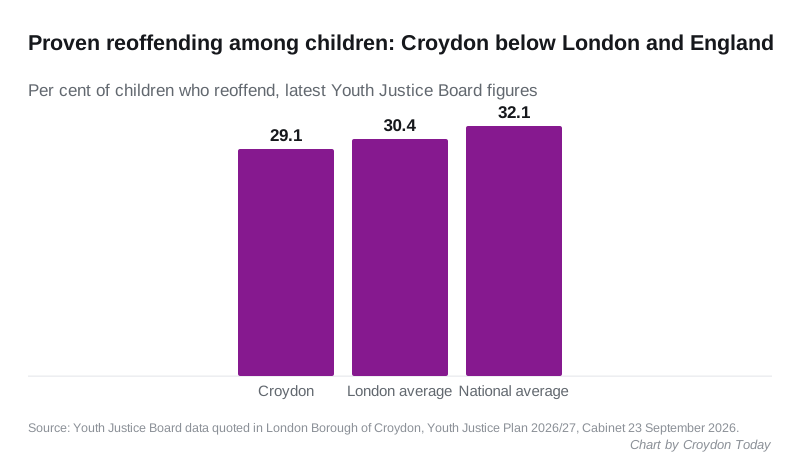
The gap is modest, 1.3 percentage points below London. The plan calls it “the latest data” from the Youth Justice Board but does not say which period it covers.
Court delays of a year or more
The plan raises a problem outside the council’s control. It says some children are “appearing at Court 12+ months after the offence was committed”, and are kept on “onerous bail packages” until trial.
The service raised this with the police, the Crown Prosecution Service and the courts during 2025/26. It says the delays appear to be specific to London, not to Croydon. It also says they distort its first time entrant figure, which would have fallen further “had matters been dealt with swiftly”.
Serious youth violence
The plan reports a fall in serious youth violence in 2025/26, most notably in personal robbery and possession of an offensive weapon. It also records “a small but significant increase in firearm related offending not seen in the previous year”. It does not publish the number of firearm offences in the text.
Violence against the person remains the largest category of offending the service deals with.
Who is in the system
The plan is frank about two groups:
- Children in care. 75 of the 269 children were looked after by a council, 27% of the caseload. That included 32% of the girls. 29 of the 75 had been placed in Croydon by other councils. This month the council also replaced the provider of one of the children’s homes it commissions (our report).
- Black and mixed heritage children. The plan calls disproportionality “a stubborn challenge”. It says 2025/26 brought the service’s first fall in the number of Black and mixed heritage children, but that Black children “remain over-represented”. It notes they are more likely to be excluded from school and more likely to be stopped and searched.
Two thirds of the children the service worked with, 178, were known to children’s social care.
What it means for you
If you are a parent, the plan’s figures say a child in Croydon is now more likely to be stopped and searched than a year ago, but less likely to end up with a first conviction or in custody. The rise in searches is the number the plan leaves unexplained.
The plan now goes to Full Council. The Youth Justice Plan and its appendix are published in full on the council’s website, and residents can ask a question at any ordinary Full Council meeting by submitting it at least seven working days beforehand (Croydon Council: how to ask a council question).
Have your say