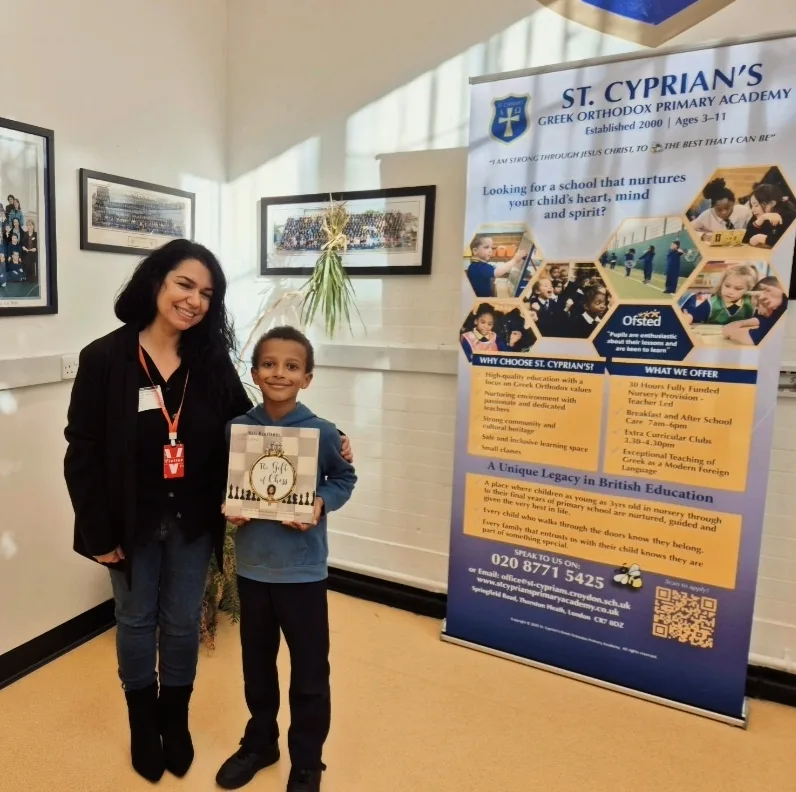

Author Hari Neocleous ran two chess workshops at St Cyprian's in Thornton Heath on 20 November, reading The Gift of Chess and playing rook games with pupils.
Children’s author and maths teacher Hari Neocleous ran two chess workshops at St Cyprian’s Greek Orthodox Primary Academy in Thornton Heath on Friday 20 November, reading from her book The Gift of Chess and teaching pupils to play with the rook.
The visit was organised by St Cyprian’s Fellowship, the school’s parent teacher association. It was Hari’s first author visit, she wrote afterwards on the LogiqBoard blog, and she called it “a magical day indeed”.
The Fellowship describes Hari as a specialist mathematics teacher with experience of supporting children with special educational needs. The Gift of Chess is her children’s book about the life lessons the game can teach.
A Greek island assembly first
Before the workshops, Hari was invited to watch Year 3’s class assembly. The class is named Zakynthos, and the assembly was about the Greek island. A group of boys played guitars, and there was music, singing and Greek dancing.
“I felt a wave of emotions,” she wrote. “I’ve worked in a Greek school in the past. These children today sounded different, they spoke Greek as if it was their mother tongue and not their heritage language/second language or an additional language they learn at school. It was beautiful.”
“As I soaked up the atmosphere, I watched the reactions of parents, students and staff. I knew right then I was in a very special place.”
Rooks and gems
Zakynthos class came to her workshop straight after their performance. Some of the 7 and 8 year olds had never played chess; others already knew how. Hari read from the book, introduced the rook and how it moves and captures, then set the class playing minigames.
In the first, “Rooks and Gems”, each player tries to collect the most of nine gems placed on the board. Later rounds let one rook capture the other, which ends the game. Hari used LogiqBoard, which the Fellowship describes as an interactive educational platform for reasoning, strategic thinking and problem-solving, on the classroom’s interactive whiteboard to show each move and the common mistakes: a rook cannot jump, cannot move diagonally and cannot make an “L shape”.
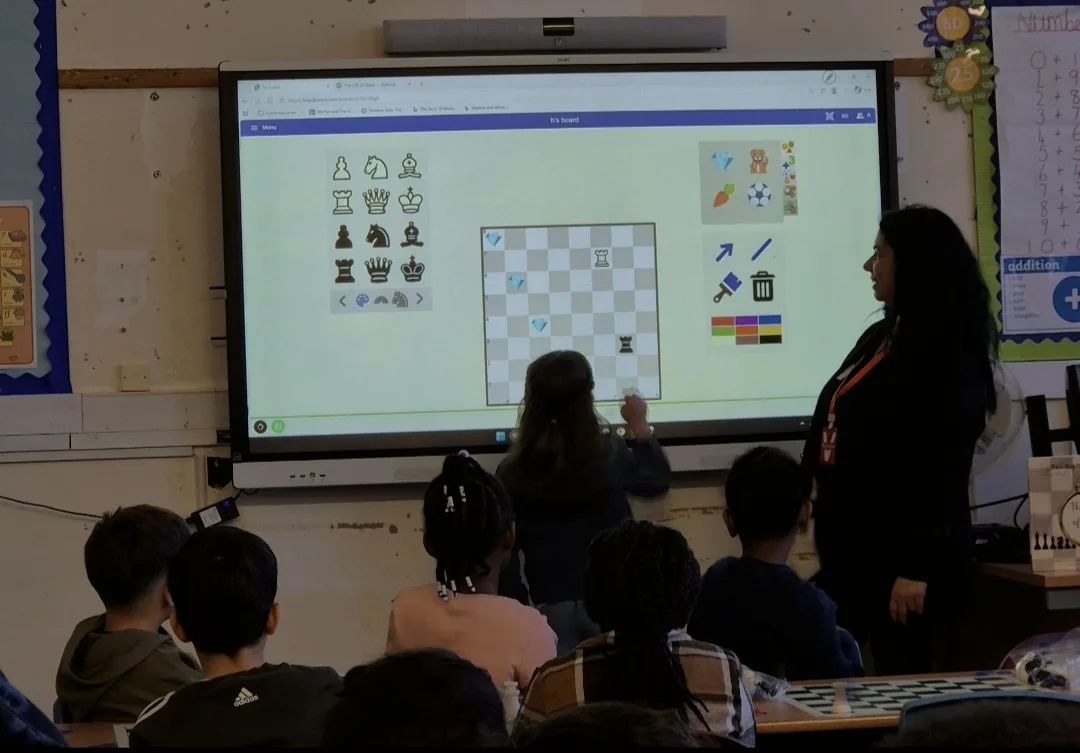
“The session was pacey, exciting and these young 7 and 8 year olds were passionate about chess!” she wrote. “One student told me she felt satisfaction as she captured a rook, I noticed her huge smile from across the room!”
The Fellowship said the activities had pupils thinking ahead, explaining their decisions and working together. “Throughout both sessions, pupils discovered that chess is about much more than winning or losing,” it said. “It encourages patience, resilience, concentration, creativity and learning from mistakes.”
Seeing themselves in a book
Back at story time, the class picked out details in the book’s illustrations, which are by Diriq. “From my big greek messy hair, the ancient ruins or the musician playing the Greek lyra, I could feel the sense of pride amongst the Saint Cyprian students,” Hari wrote. “They could see something in my book that was a part of their world.”
Which chess piece would you be?
The second workshop was for a smaller group of chess players of mixed ages, from Year 2 upwards. They played a rook and pawn game called Capture the Flag, then invented their own version in which pawns could be promoted, which meant changing the winning rule too. They worked through a puzzle in which the chess pieces had been swapped for fruit and vegetables, and finished with a team game on LogiqBoard where the first side to put the king in check wins.
Hari asked the group which chess piece they would be in life. “One of the boys wanted to be the queen, he knew how powerful she was. She was the popular choice,” she wrote. “One saw himself as a rook, being solid and hard-working. Another chose the bishop, who appears when no one expects it to.”
The Fellowship said the visit was also a chance to look at chess becoming a more regular part of school life. Hari wrote: “Inspiring a child to pick my book to read or to learn chess is a great feeling. And inspiring a school to bring chess into its school day is just as wonderful.”
Part of a run of visitors
The Fellowship brings visitors into the school as part of its enrichment programme. Earlier this month children’s author Zoe Antoniades read from her Cally & Jimmy books to pupils, and fetal medicine specialist Professor Kypros Nicolaides visited before that (our report on the Fellowship).
St Cyprian’s, on Springfield Road, describes itself as the UK’s only state-funded Greek Orthodox primary school. It teaches the national curriculum alongside Greek language, Orthodox Christian values and Greek heritage, and the Fellowship says it welcomes children from all backgrounds.
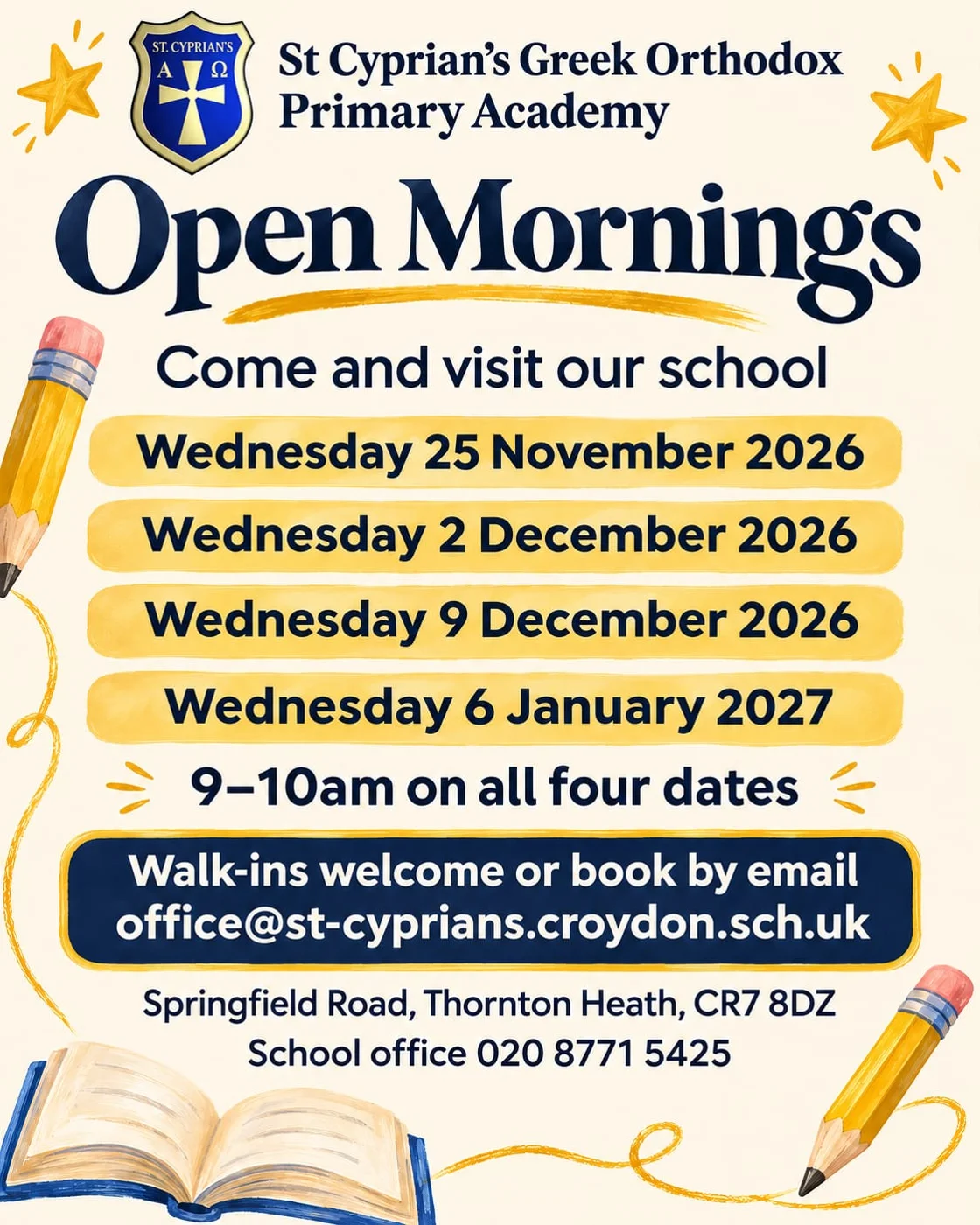
The school’s next open morning is on Wednesday 25 November, with more on 2 and 9 December and 6 January 2027, all from 9am to 10am.
Hari’s full account of the day, with her minigame rules and puzzles, is on the LogiqBoard blog. More on the Fellowship is at stcypriansfellowship.org.uk.
Have your say