
Croydon spent £24.5m taking children with SEND to school in 2025/26, more than double six years earlier. Cabinet approved a new £213m deal on 18 November.
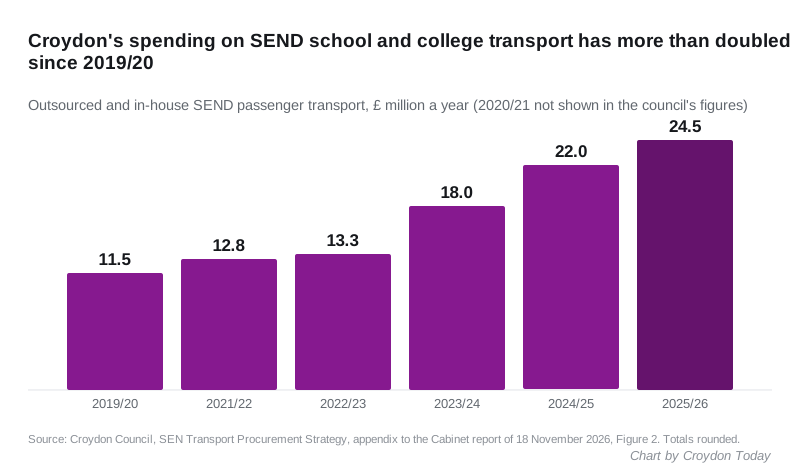
Croydon Council spent about £24.5m in 2025/26 taking children and young people with special educational needs and disabilities (SEND) to school and college. Six years earlier it spent about £11.5m.
The council’s own benchmarking puts its SEND transport costs “amongst the highest in London”. The figures are in papers for the Executive Mayor and Cabinet on Wednesday 18 November (Cabinet report).
Updated 19 November: Cabinet approved the new framework on 18 November, subject to call-in until 26 November.
Cabinet has approved a new way of buying the service (decision). It will be an open framework of taxi, minibus and coach firms, lasting up to eight years, with an estimated value of £213m before VAT.
How the bill has grown
The spending comes from an appendix to the report, which breaks the cost down year by year (procurement strategy appendix). The totals below add the council’s outsourced and in-house transport together:
| Year | Outsourced | In-house | Total |
|---|---|---|---|
| 2019/20 | £10.7m | £0.7m | £11.5m |
| 2021/22 | £10.8m | £2.0m | £12.8m |
| 2022/23 | £11.0m | £2.3m | £13.3m |
| 2023/24 | £15.3m | £2.7m | £18.0m |
| 2024/25 | £18.9m | £3.0m | £22.0m |
| 2025/26 | £21.1m | £3.3m | £24.5m |
The appendix does not give a figure for 2020/21.
Transport for adults going to care settings costs far less, about £0.8m a year. That is roughly 3p in every pound the council spends on passenger transport.
Why it is rising
The main driver is the number of children with an Education, Health and Care Plan (EHCP). The appendix charts both numbers:
- children with an EHCP: 2,217 in 2015/16, rising to 6,273 in 2025/26
- children on council transport: 1,121 in 2015/16, rising to 2,240 in 2025/26
So about 36% of Croydon children with an EHCP now get transport from the council. The report also says more special school places are being created inside the borough, which adds to the numbers travelling.
The appendix warns that the service is planning for only an inflation rise in its budget, while need keeps growing. It says that “implies real financial strain and limited headroom to absorb further shocks”.
A handful of firms carry most of it
The council buys most of its routes from private operators. According to the appendix:
- the ten biggest suppliers take about 79% of the spending
- the single largest takes just over 22%
- a longer tail of smaller local taxi and minibus firms runs the rest
The current arrangement, a dynamic purchasing system, started on 1 September 2019 and ends on 31 August 2027. It cannot be extended, and the law it was set up under has since been replaced by the Procurement Act 2023.
The report rejects handing the whole service to one provider. It says a failure there could “affect approx. 2000 children and young people simultaneously”.
What it means for you
The council’s legal duty to provide free transport for eligible children does not change. The report says the recent Education White Paper raises questions about EHCPs and placements, but that there is “no suggestion” home to school transport will stop being a statutory requirement.
What may change is how your child travels. The council says it wants to:
- cut the number of high-cost and single-pupil routes, moving children onto shared ones where that suits them
- bundle routes to serve key schools more efficiently
- offer independent travel training from around Year 9
- offer personal transport budgets to more families who want to arrange their own travel
- look at sharing taxis with neighbouring councils
The report says a separate review of the cost of the service is running alongside the procurement, and that the new framework carries no guaranteed volumes so it can follow whatever that review recommends.
The council’s school travel assistance page sets out who qualifies, how independent travel training works and how to appeal a travel decision.
What happens next
The report sets this timetable:
- 18 November 2026: Cabinet approved the strategy
- 26 November 2026: last day for councillors to call the decision in; it takes effect on 27 November if they do not
- January 2027: tender published
- February 2027: bids due and evaluated
- April 2027: framework awarded
- June 2027: operators start mobilising
- September 2027: new arrangements in place for the school year
Cabinet also gave the Corporate Director of Place the power to award places on the framework and individual contracts. The director will get an annual report listing every appointment and contract awarded (agenda and decisions).
Have your say