
The Night Tube is 10 and still misses Croydon. We checked the trains and night buses home to nine local stops, on three kinds of night. Checked November 2026.
The Night Tube is 10 years old and still has no stop in Croydon, so getting home here in the small hours means a night bus or one of the hourly trains that run through the night from Blackfriars or Victoria, depending on the night. Transport for London (TfL) marked the anniversary on Thursday 5 November with London After Dark, a report written with Time Out, which says more than 81,000 Night Tube journeys are now made on an average night.
The report’s headline finding is that 88 per cent of the Londoners questioned have stayed out later because they knew public transport was running. From Croydon, that depends on knowing which station to walk to. Brixton, the end of the Victoria line, is the nearest Night Tube stop the planner sends Croydon passengers to. West Croydon is on the Windrush line by day, but that line’s night trains run between Highbury & Islington and New Cross Gate.
Which station has a train, and when
We checked direct trains to East Croydon on TfL’s journey planner on 5 November, for nights through November and into early December. The pattern held across them, with the exceptions below, and it changes on a Saturday night.
| Night | Where to go | Trains to East Croydon |
|---|---|---|
| Monday to Friday nights (early hours of Tuesday to Saturday), and Sunday nights | Blackfriars | Thameslink at 01:40, 02:40, 03:40 and 04:40, about 26 minutes |
| Saturday night (early hours of Sunday) | Victoria | Southern at 01:08, 02:08, 03:08, 04:10 and 05:02, about 24 minutes |
The trap is that each station’s service stops on the other’s night. On a Friday night the last direct train from Victoria is the 00:15, and the next is the 05:08 on Saturday morning. On the Saturday night of 14 November the last Thameslink from Blackfriars is the 01:02, and the planner offered nothing more from there until 09:31 on Sunday morning. London Bridge has a long gap too: on Wednesday 18 November the planner’s last train left at 00:35, with the next at 05:35.
The trains also go past East Croydon. The planner has the Blackfriars trains at 02:40, 03:40 and 04:40 carrying on to Purley, 33 minutes from Blackfriars, and the Saturday night trains from Victoria reaching Purley in about 30 minutes. Two Saturday nights are different: on the early hours of 22 November and 6 December the planner showed a change on the way from Victoria and a journey of about an hour or more.
How long it takes to get home
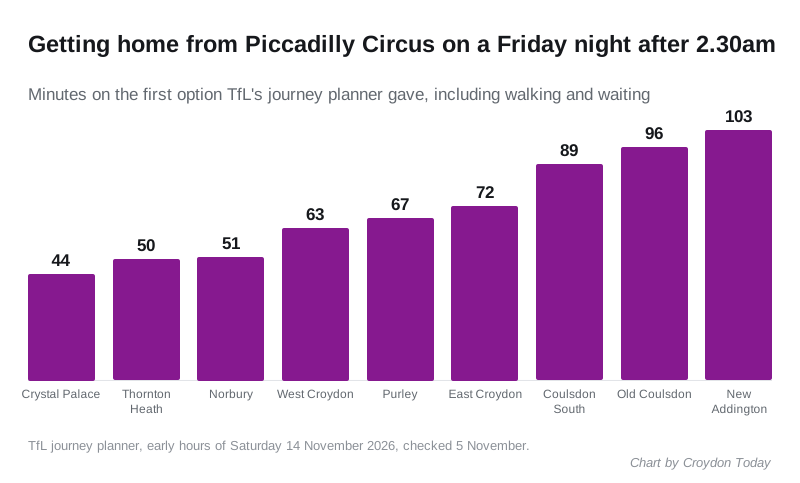
We asked the planner for the first option after 2.30am from Piccadilly Circus on three nights: the early hours of Saturday 14 November (Friday night), Sunday 15 November (Saturday night) and Wednesday 18 November (midweek, with no Night Tube). The times include walking and waiting.
| Going to | Friday night | Saturday night | Midweek |
|---|---|---|---|
| Crystal Palace | 44 min: Tube to Brixton, N3 | 44 min: Tube to Brixton, N3 | 42 min: N3 |
| Thornton Heath | 50 min: Tube to Brixton, N250 | 50 min: Tube to Brixton, N250 | 51 min: N3, N250 |
| Norbury | 51 min: Tube to Brixton, N109 | 51 min: Tube to Brixton, N109 | 48 min: N109 |
| West Croydon | 63 min: Tube to Brixton, N109 | 63 min: Tube to Brixton, N109 | 60 min: N109 |
| Purley | 67 min: N136, N89, train from Blackfriars | 55 min: Tube to Victoria, train | 78 min: N38, N2, N68 |
| East Croydon | 72 min: Tube to Brixton, N109, 64 | 49 min: Tube to Victoria, train | 62 min: N38, N2, N68 |
| Coulsdon South | 89 min: Tube to Brixton, N109, N68 | 74 min: Tube to Victoria, train, N68 | 80 min: N38, N2, N68 |
| Old Coulsdon | 96 min: Tube to Brixton, N109, N68 | 81 min: Tube to Victoria, train, N68 | 86 min: N38, N2, N68 |
| New Addington | 103 min: Tube to Brixton, N109, 64 | 92 min: Tube to Victoria, train, 64 | 101 min: 139, N89, train, 64 |
So the Night Tube barely moves the journey time to the north of the borough. West Croydon came out three minutes slower on the Friday by Tube and bus than on the direct N109 midweek, and Norbury three minutes slower too. These are single planned journeys, not measured ones, and a different departure could change the order. The Tube’s advantage may be waiting time: for West Croydon the planner’s Friday options left Piccadilly Circus at 02:33, 02:53 and 03:13, while the midweek N109s were 30 minutes apart, at 02:43, 03:13 and 03:43.
The planner’s first option is not always the best one. On the Friday night a journey leaving at 03:05 by N136, N89 and the Blackfriars train reached East Croydon at 04:06 in 61 minutes, against 72 for the first option.
Three night routes run from central London into the borough, on TfL’s route data. The N109 runs from Oxford Circus through Brixton, Norbury and Thornton Heath Pond to West Croydon and the Whitgift Centre. The N68 runs from New Oxford Street to East Croydon, Purley, Coulsdon and Old Coulsdon. The N3 from Oxford Circus ends at Crystal Palace. The N250 starts at Brixton and serves Thornton Heath, West Croydon, East Croydon and Fairfield Halls, which makes it the other bus to look for off the Victoria line.
Selsdon and Sanderstead are the hardest. The planner’s first options after 2.30am did not leave central London until after 4am: on the Friday night, 04:05 to Selsdon Library, arriving at 05:37, and 04:24 to Sanderstead station, also arriving at 05:37.
What the report found
Time Out’s research community, Time Out Loud, supplied about 200 Londoners for a week-long study between 16 and 23 September, using surveys, diaries, creative tasks and personal stories. The report also draws on interviews with six people from the night-time economy, among them a Night Tube driver.
- 88 per cent of those questioned have stayed out later because they knew public transport was running
- 77 per cent say knowing how they will get home is an important factor in deciding where to go
- 55 per cent believe great nights out are increasingly spread across the capital rather than concentrated in central London
Restaurants, theatre, live music and cultural activities now play a more central part in nights out than they did before, the report says. TfL’s list of new nightlife names nowhere in Croydon: Apple Music Hall at Battersea Power Station, Blue Note in Covent Garden, the Ironworks warehouse venue at the Royal Docks, fabric’s concerts at St Paul’s Cathedral, protected status for Heaven and next summer’s 20th birthday shows at The O2.
The report follows a separate Time Out analysis that put London first among 26 European capitals for nightlife and public transport combined, ahead of Vienna and Paris. It drew on 5,848 responses in 23 languages, with people rating their own city on a five-point scale and the two scores weighted equally.
Ten years in numbers
The first Night Tube ran on the Central and Victoria lines on 19 August 2016, and the Jubilee, Northern and Piccadilly lines followed later that year. TfL gives these figures:
- More than 50,000 journeys on the first night
- More than 81,000 journeys on an average night now, with Saturdays typically busier than Fridays
- More than 67 million customers carried on Night Tube and Night Overground services since 2016
- 50 Night Tube stations with step-free access, including the recently upgraded Colindale, Knightsbridge and Northolt
Step-free work is under way at Burnt Oak and Leyton, with enabling works at South Kensington due later this year. All stations are staffed while open and have full CCTV coverage, TfL says. It also says it is on track for high-speed mobile coverage across the whole Tube network, including in tunnels, by the end of the year, with more than 70 per cent of underground stations already covered by 4G and 5G.
What they said
The Mayor of London, Sadiq Khan, said: “For the past decade, the Night Tube has been a defining feature of London as a world-leading 24-hour city, helping Londoners and visitors enjoy everything our great capital has to offer, and supporting our vital workers and businesses to boost our night-time economy.”
He added: “This report really brings to life how The Night Tube connects Londoners and visitors with our city’s incredible cultural offering, helping people discover new venues and events in new parts of the capital while ensuring they can travel home safely and affordably at any hour.”
Claire Mann, TfL’s Chief Operating Officer, said: “London at night has changed significantly over the past decade, and the Night Tube has evolved alongside it, helping people travel to work, meet friends and enjoy everything the capital has to offer after dark.”
Coral Anderson, co-owner and managing director of Swift Bars, said: “When people know they can get home easily, they’re more likely to explore a new neighbourhood, stay for another drink and make the most of everything London has to offer.”
Ed Richardson, programme director for transport at BusinessLDN, said: “Reliable late-night transport is essential to a thriving 24-hour city, giving Londoners and visitors the confidence to enjoy everything London has to offer. Keeping the city moving after dark will be key to helping its night-time economy continue to thrive.”
What it means for you
- Most nights after about 1am: head for Blackfriars and the hourly Thameslink. On a Saturday night, head for Victoria instead.
- Next week: a revised Thameslink timetable runs through the Purley area after 11pm from Monday 9 to Thursday 12 November, so check the night you travel. This month’s other closures are on our Croydon roadworks and travel page.
- Fares: Night Tube fares are off-peak, and a Day Travelcard stays valid for journeys starting before 04:30 the next day.
- Any night but Friday or Saturday: the Night Tube does not run, so the direct N109, N68 and N3 are what you have from the West End.
- Daytime trains: times, fares and the fastest runs are on our Croydon trains to London page.
TfL’s release is on its newsroom. Time Out offers the full report as a download.
Have your say