
Croydon's 2025-26 accounts get a disclaimer from Grant Thornton, partly over £245.9m of government support not yet confirmed. Councillors meet on 12 November.
Croydon Council’s accounts for 2025-26 will not get an audit opinion. Its auditor, Grant Thornton, has issued a draft “disclaimer of opinion”, which means it says it could not gather enough evidence to say whether the accounts are free of material error (draft audit opinion).
It is the sixth year running. The council’s own report says the accounts for 2020-21 to 2024-25 all received disclaimer opinions under the government’s “backstop” rules, so the auditor has no assurance on the balances the 2025-26 accounts start from (council report).
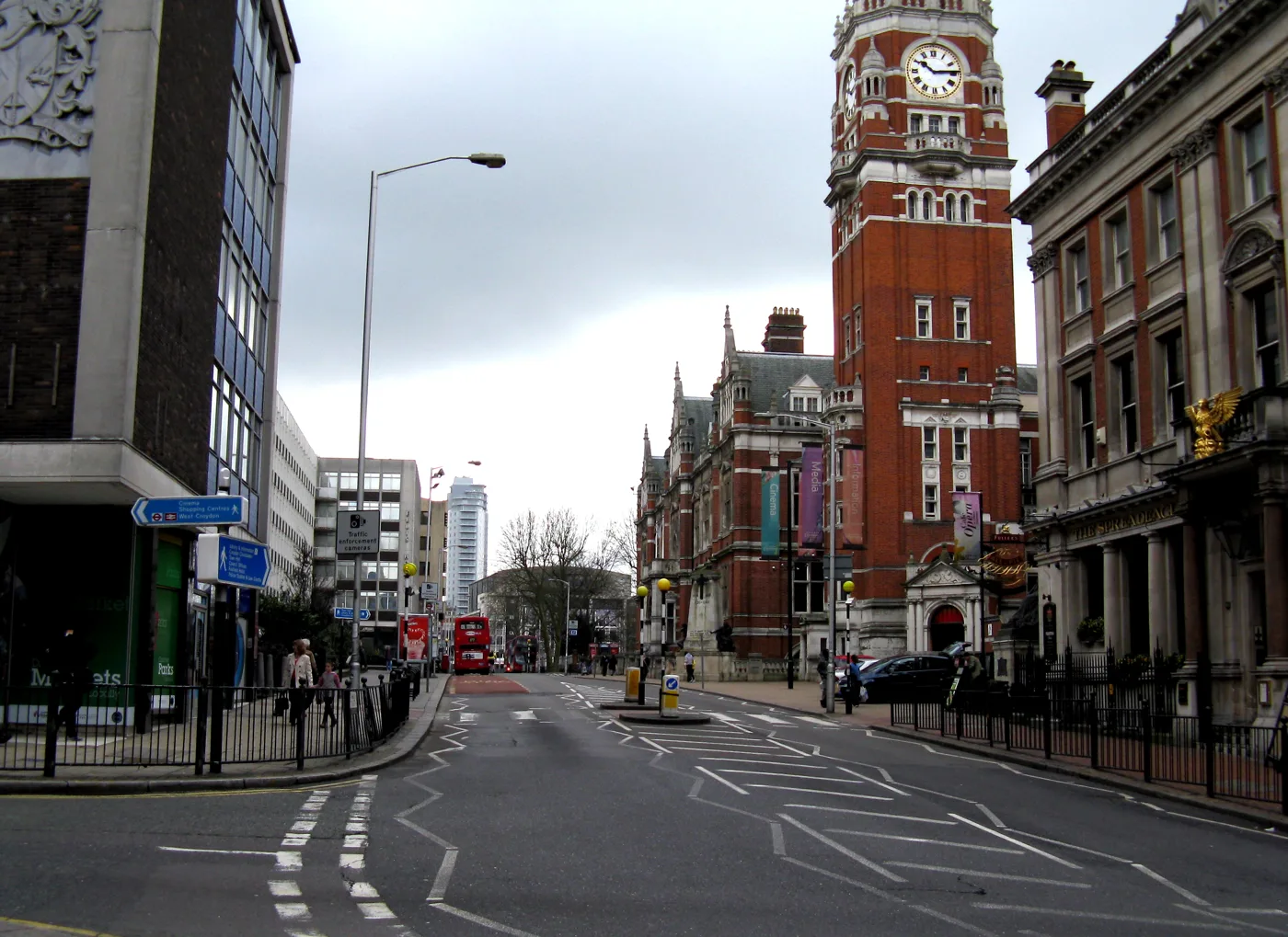
The papers go to the council’s Audit and Governance Committee at the Town Hall on Thursday 12 November at 6.30pm (agenda).
Why the auditor would not sign
The backstop is the main reason. Regulations made in 2024 set 31 January 2027 as the date by which councils must publish audited 2025-26 accounts, and the auditor says it could not get enough evidence by then.
Grant Thornton also names two problems it says would have changed its opinion even without the backstop:
- £245.9m of government support not yet confirmed. The accounts count capitalisation directions for 2023-24, 2024-25 and 2025-26 worth £245.9m. These let the council pay day-to-day costs from borrowing or asset sales. The auditor says the Ministry of Housing, Communities and Local Government has not yet confirmed the council can include them.
- Leases left out. The accounts do not include the entries needed under the IFRS 16 lease accounting standard, and the council has not worked out the full values.
The council’s report says Grant Thornton found its work better and quicker than for 2024-25. But it also says 2027-28 is the earliest year the council could start to win back full assurance.
The money behind it
The auditor’s findings report sets out how far Croydon still leans on government help (audit findings report):
- £525.7m of Exceptional Financial Support received from 2019-20 to 2025-26. Of that, £279.8m is confirmed and £245.9m is approved in principle only.
- £1,769m of debt at the year end, of which £328m is short term.
- Cash and cash equivalents of £26.1m, down from £78.4m a year earlier, with a bank overdraft of £34.8m, up from £4.4m.
Usable reserves stood at £218.7m on 31 March 2026, down £40.6m in the year. The council says £37.1m of that fall was planned, mostly to pay for building projects (council report).
Two significant weaknesses
Auditors must also say whether a council has proper arrangements for spending money well. Grant Thornton found two significant weaknesses (draft audit opinion).
The first is Croydon’s continued reliance on government financial support. The auditor says this has left “an unsustainable debt burden” and a government-appointed commissioner model. It has kept in place its statutory recommendation that the council work with the government, through the commissioners, on a package to make its costs affordable.
The second is the schools high needs budget, which pays for pupils with special educational needs. The council missed its “safety valve” targets in both 2024-25 and 2025-26, the auditor says. It overspent by £29.4m in 2025-26, taking the cumulative deficit from £28m to a provisional £57.6m.
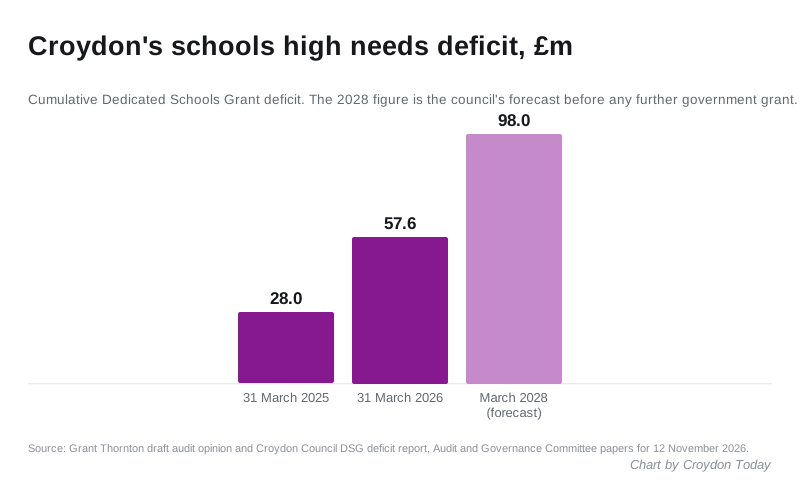
A separate report to the same meeting says the government has awarded Croydon a High Needs Stability Grant of £49,750,756, due to be paid on 30 November. That covers most of the £57.6m, leaving about £8m (DSG deficit report).
The relief may not last. The report assumes an overspend of £45m in each of 2026-27 and 2027-28. On that basis the deficit would reach £98m by the time the “statutory override”, which keeps it off the council’s main budget, ends on 31 March 2028. The report says there is no guarantee the Department for Education will keep paying for most of it. In September we reported the council’s earlier forecast of £96m.
The same report says Croydon now has the highest rate of requests for Education, Health and Care assessments in London, with about 6,500 plans in place.
Corrections the audit made
The audit changed several figures between the draft and final accounts. Among them, according to the council’s report:
- a £1.8m debtor balance for “cash in transit” could not be backed up, so it was removed and charged to the revenue accounts
- £1.4m of refuse vehicle hire costs had been wrongly treated as capital spending and were moved to revenue
- the provision for refunding fines from the six low traffic neighbourhoods ended by the court was cut by £2m, from £3.3m to £1.3m, in line with refunds paid so far
On that last point, the auditor says it “may be understated” given how much the schemes raised, though it notes the council’s commitment to repay. Our report on the LTN ruling and refunds explains how to claim.
What it means for you
A disclaimer does not mean money has gone missing, and it does not stop services running. It does mean nobody independent has been able to stand behind Croydon’s figures for six years. That matters while the council asks residents about a 4.99% council tax rise, in its 2027/28 budget consultation, open until 30 November.
The committee is asked to let the council’s finance director and the committee chair sign the accounts. Finished documents return to the committee on 3 December 2026. The council must publish its audited accounts by 31 January 2027.
The meeting is open to the public, in the Council Chamber at the Town Hall, Katharine Street, CR0 1NX. The same meeting hears that the council has recovered 25 homes from tenancy fraud since April.
Have your say